SDK
One typed client for the Boost.space REST API, in four languages. TypeScript, Python, PHP, and Go are all generated from the same OpenAPI spec that powers the API Reference — so the client surface always matches the API. Each ships 74 resources, fully typed models, and 165 relationship-navigation methods.
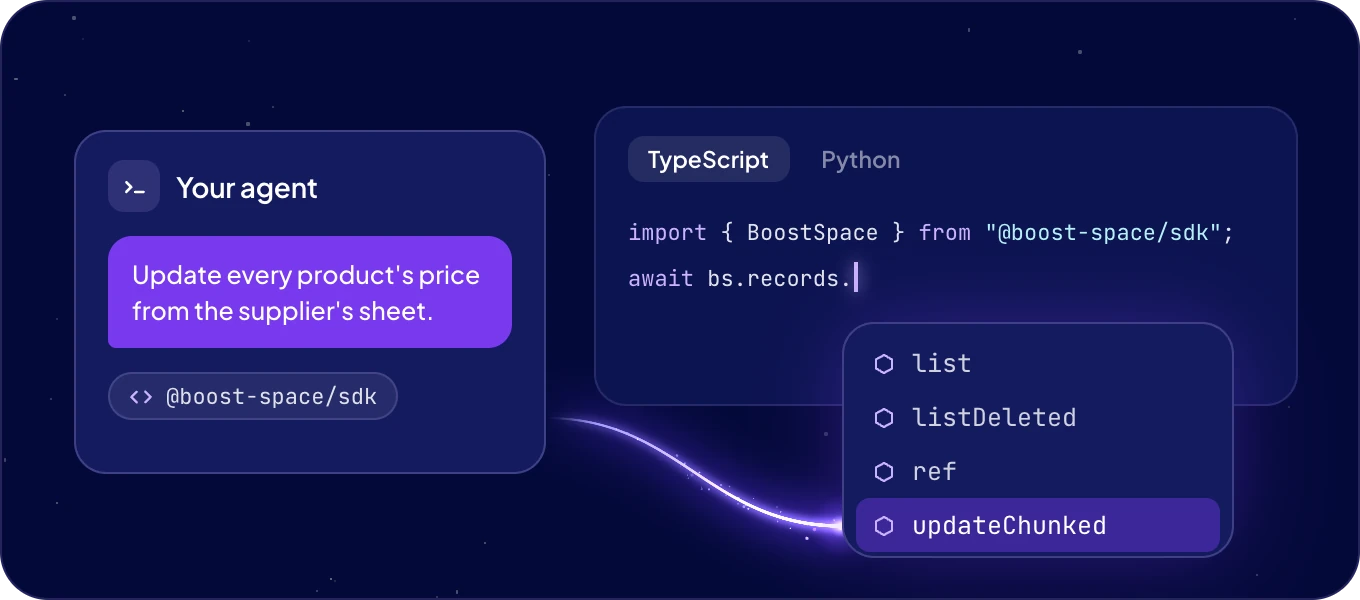
Generated from the SDK's own source of truth, so these docs always match the shipped packages.
Should you use the SDK?
If you are writing code against Boost.space in TypeScript or Python, yes — there is no reason to hand-roll HTTP. You get the same endpoints plus typed models, automatic retries, pagination you can iterate over instead of managing offsets, filters you compose instead of string-building, and bulk helpers that chunk a large batch and report per-chunk failures.
Reach for the REST API directly when your language has no SDK yet, or when you need the exact wire format. Reach for MCP when an AI agent is deciding what to do rather than you writing the steps out.
Get started in two steps
1. Install (TypeScript and Python are on the public registries; PHP and Go are coming soon):
npm install @boost-space/sdk    # TypeScript
pip install boostspace-sdk      # Python
2. Make your first call:
import { BoostSpace } from "@boost-space/sdk";
// `system` is your tenant, e.g. "acme" → https://acme.boost.space/api
const bs = new BoostSpace({ token: process.env.BS_TOKEN!, system: "acme" });
const space = await bs.spaces.get(42);
Full auth options (tokens, providers, OAuth, MCP) are in Authentication.
Guides
Concepts that apply across all four languages:
| Guide | What's inside |
|---|---|
| Authentication | API tokens, token providers, OAuth, MCP |
| Filtering | The full filter grammar with tested examples |
| Ordering & pagination | Sort grammar and Paginator idioms |
| Errors & retries | Typed errors and automatic retries |
| Record handles | Lazy ref handles, caching, call costs |
| Relations & expand | Relationship navigation and expansion |
| Delta sync & bulk | Change feeds and bulk operations |
| Testing & mocking | Test against the SDK safely |
Reference
One page per resource — Records, Fields, Files, Labels, Modules, Spaces, Users, and more — generated from the spec: SDK API reference.
What every SDK guarantees
- Bearer authentication with your API token
- Automatic retries with backoff
- Header-driven pagination (
X-BoostSpace-FoundRecords), exposed as native iteration - Typed errors carrying both the HTTP status and the internal Boost.space
code
Base URL is per-tenant: https://{system}.boost.space/api (system = your system name).
SDK vs. REST
| Use… | When |
|---|---|
| An SDK | You're in TypeScript, Python, PHP, or Go — get types, retries, pagination, and relationship helpers |
| The REST API | Any other language — copy-paste code samples per endpoint |
Packages: npm · PyPI · SDK changelog.
